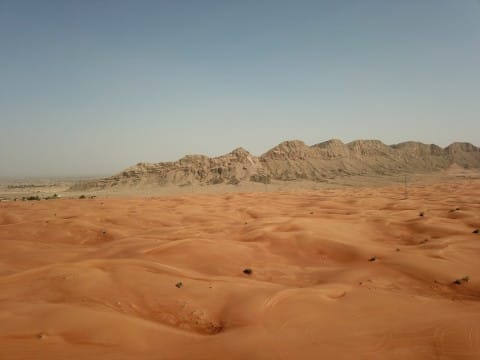
New archaeological findings from Jebel Faya in Sharjah reveal that early humans not only passed through the region but lived and thrived there, adapting to shifting climates and crafting advanced tools 80,000 years ago. These discoveries could significantly strengthen the case for the site’s inclusion on UNESCO’s World Heritage list.
Published in the peer-reviewed journal Archaeological and Anthropological Sciences, the study details the excavation of finely crafted stone tools used for hunting, butchery, and tool-making. Conducted between 2012 and 2017, the research was led by the Sharjah Archaeology Authority (SAA) in partnership with German and British institutions, and funded by the German Research Foundation and the Heidelberg Academy of Sciences.
The area, referred to as the “Faya Palaeolandscape,” includes Jebel Faya’s limestone escarpment and its surroundings. Archaeological evidence indicates human presence in the region as far back as 210,000 years ago, but the newly analyzed tools—dated using luminescence techniques—confirm that people lived there during the closing phase of a climatic period known as marine isotope stage 5a.
Dr. Knut Bretzke, head of the German Archaeological Mission in Sharjah, emphasized that ancient residents seized short windows of wetter climate—brought by Indian Ocean monsoons—to settle in what would otherwise be desert. The tools reflect a level of sophistication in technique, specifically through a process called “bidirectional reduction,” involving careful strikes on both ends of a stone core to create efficient, multipurpose blades.
“These weren’t just survivors; they were innovators,” said Dr. Bretzke. “Their techniques reflect deep knowledge of the environment and cognitive complexity.”
Eisa Yousif, director of the SAA, said the discoveries show how resilience and adaptability have long defined humanity. “As we push for UNESCO recognition of the Faya Palaeolandscape, these findings remind us that our ancient past still informs who we are today,” he said.
UNESCO’s decision on the site’s World Heritage status is expected between July 7 and 16 at its 47th session in Paris. If successful, Jebel Faya would join Al Ain as the UAE’s second site on the list.